Most of the reliability practices on this blog assume you have an SRE team, or at least an engineer who can own a dashboard. That’s a reasonable assumption for a platform team. It’s a bad one for the five-person company running a WordPress site and a Stripe integration, who finds out their checkout page is broken the same way they find out most things are broken: a customer emails them.
SREmonitor.io is built for that gap. It’s a website monitoring platform that bundles uptime checks, Core Web Vitals, and GDPR compliance scanning into one dashboard — taking the same SLI/SLO vocabulary this blog uses when discussing distributed systems and applying it to a single surface most small businesses actually have: their website. SREmonitor.io is worth a closer look, both because the website monitoring approach is sound and because it bundles something most monitoring tools leave out entirely — GDPR compliance.
Website monitoring, Core Web Vitals, and GDPR compliance in one dashboard
SREmonitor.io’s setup is a single step: paste a URL. No SDK, no agent, no DNS change. From there, SREmonitor.io runs three things in parallel:
- Uptime checks every 5 minutes, the same cadence most website monitoring tools charge a premium for.
- Core Web Vitals — LCP and CLS — tracked automatically, so a slowly degrading page shows up before it costs conversions or search ranking, not after.
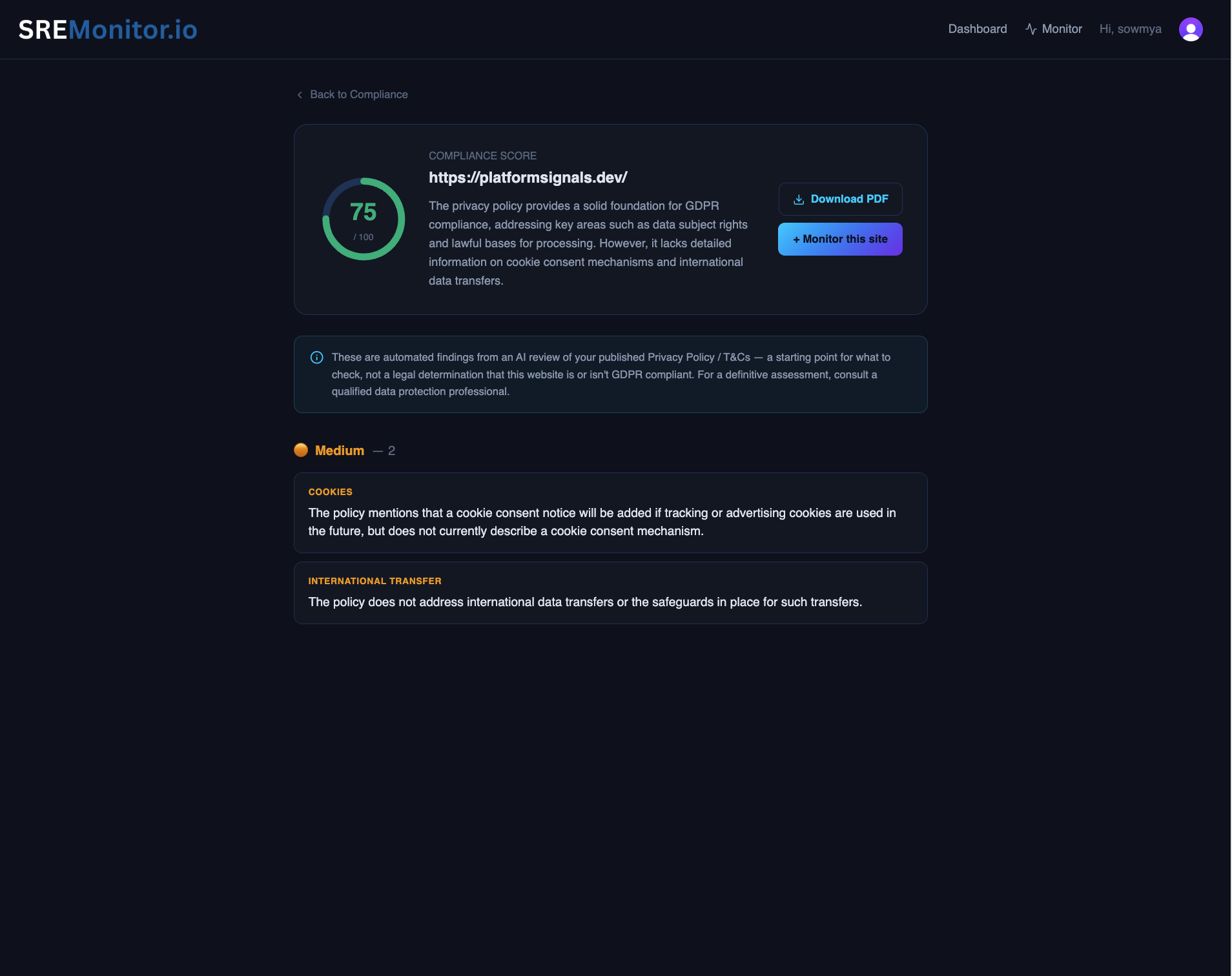
- GDPR compliance scanning against UK DPA 2018 — consent handling, data subject rights, retention statements, third-party disclosures — structured against ICO guidance rather than a generic legal checklist.
That GDPR compliance piece is the interesting one. It’s rare to see website monitoring and legal risk treated as the same category of problem, but they behave the same way: invisible until someone outside the company notices, at which point it’s an incident instead of a fix. Bundling GDPR compliance into a website monitoring dashboard, rather than treating it as a separate annual exercise, is the part of SREmonitor.io that’s actually novel.
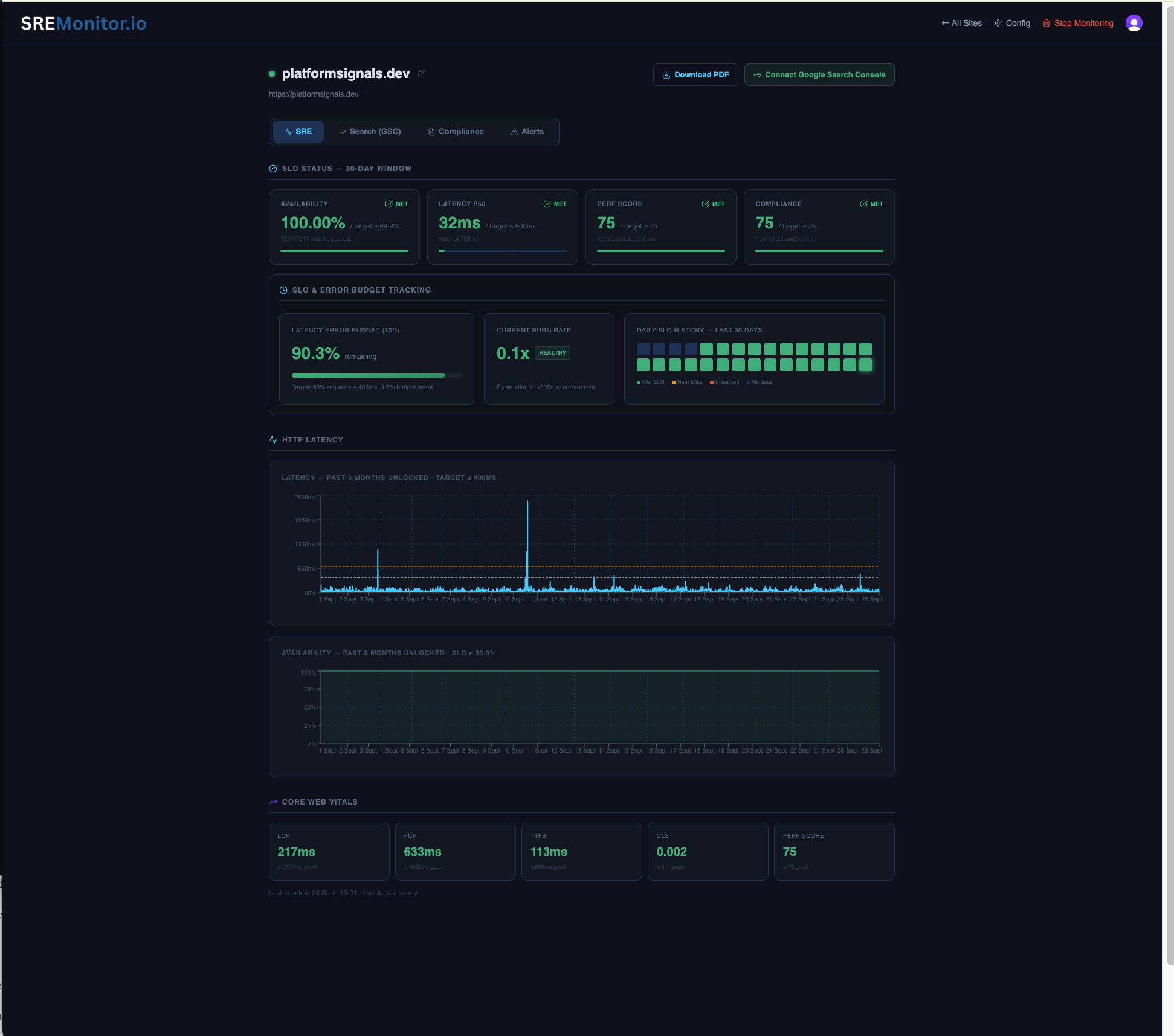
Borrowing the SLI/SLO model on purpose
SREmonitor.io doesn’t just monitor — it names things the way an SRE would. An SLI is presented as a fact (“uptime was 99.94% this month”), an SLO as the target you’re accountable to (“99.9% uptime, 95% of pages under 2s”), and the gap between the two as error budget you’re either sitting on or burning through. That framing matters more than it looks like it should. “The site felt slow last week” and “you used 40% of your latency error budget in seven days” are the same observation, but only one of them survives being repeated in a client meeting or a renewal conversation.
Each GDPR compliance issue SREmonitor.io finds comes back as a specific, non-legal-jargon recommendation rather than a score with no explanation attached — closer to a linter output than a legal opinion, which is the right register for a tool that explicitly isn’t legal advice.
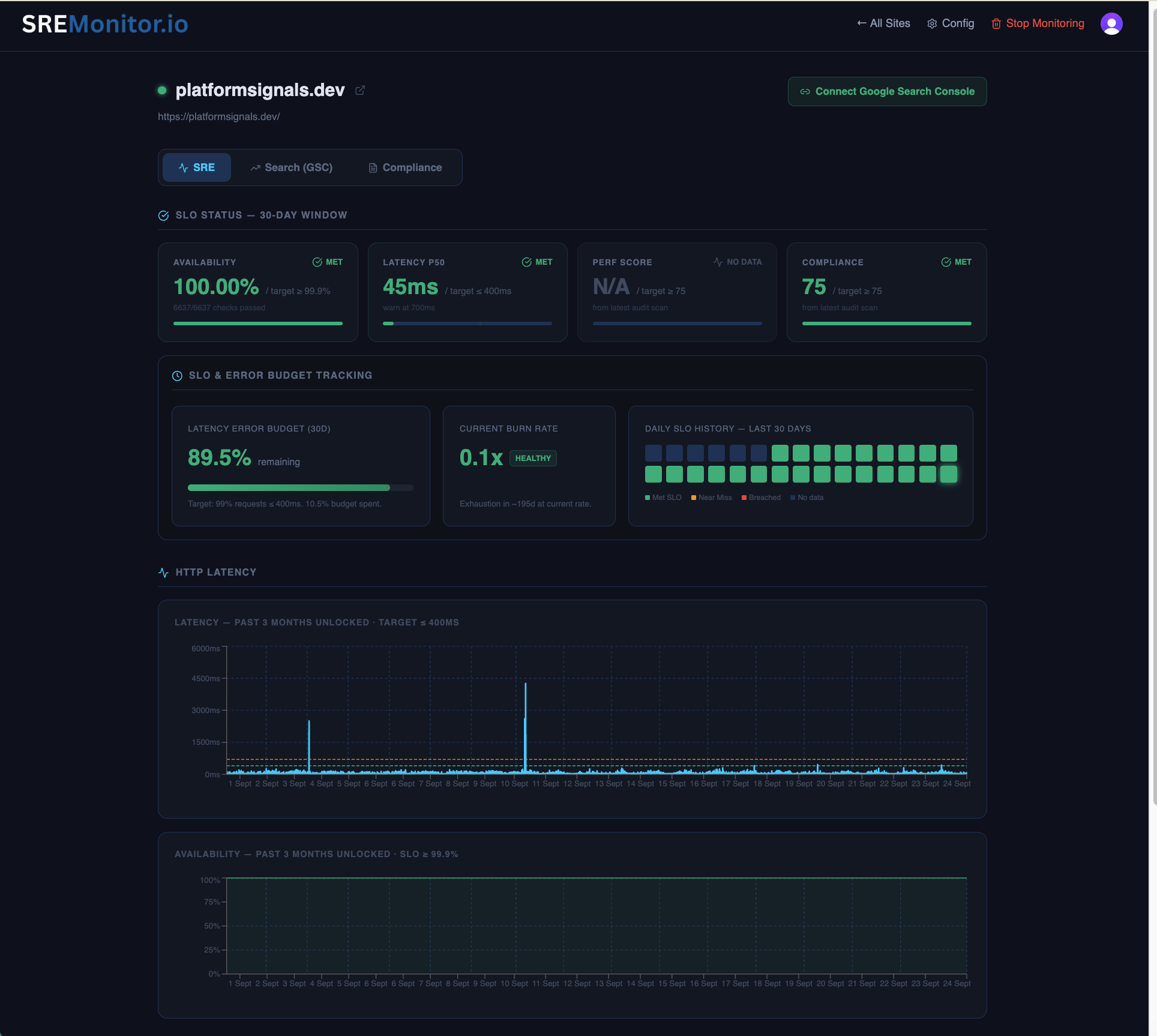
The monthly report is the actual product
Individual alerts are useful, but the artifact that makes SREmonitor.io defensible over time is the monthly operations report: uptime percentage and outage count, Core Web Vitals trend, an incident log with duration and impact, error budget consumption, and a GDPR compliance score with drift since the previous month. That’s the same shape as the reliability report an SRE team sends to leadership every month — just scoped to a business that never had the headcount to produce one.
SREmonitor.io is aimed at two audiences that don’t usually get this kind of website monitoring documentation: owners who want a number instead of a feeling, and agencies or freelancers managing sites for clients who need to show the work is actually happening, not just billed.
What’s next for SREmonitor.io
A cookie compliance scan is listed as coming soon on SREmonitor.io — loading the site in a real browser to check what fires before consent, whether “Reject” is as easy to find as “Accept,” and whether a rejection actually holds across every page rather than just the one it was clicked on. That’s a harder GDPR compliance problem than the current static scan, and a more honest one, since cookie banners are exactly the kind of thing that looks compliant in a screenshot and isn’t in practice.
Why SREmonitor.io is worth mentioning here
This blog has spent a fair number of posts arguing that reliability engineering isn’t exclusive to companies with platform teams — that the concepts (SLOs, error budgets, blameless review, and yes, treating compliance like an SLA) generalize to anyone running something other people depend on. SREmonitor.io is a fairly direct bet on that argument: same vocabulary, same discipline, aimed at businesses that will never hire for it. Three free scans, no credit card, is a low-cost way to see whether your own site’s error budget is somewhere you’d want a customer to find it first.
FAQ: SREmonitor.io, website monitoring, and GDPR compliance
What is SREmonitor.io? SREmonitor.io is a website monitoring platform that tracks uptime, Core Web Vitals, and GDPR compliance from a single dashboard, built for small businesses that don’t have a dedicated SRE or compliance team.
Is SREmonitor.io free to try? Yes — SREmonitor.io offers three free scans with no credit card required, covering uptime monitoring, Core Web Vitals, and an initial GDPR compliance scan.
How does SREmonitor.io’s GDPR compliance scanning work? SREmonitor.io scans a site’s privacy policy and data practices against UK GDPR and DPA 2018 expectations — consent handling, data subject rights, retention periods, and third-party disclosures — and returns specific, ICO-aligned recommendations rather than a generic legal opinion.
Does SREmonitor.io replace a dedicated website monitoring tool? For small businesses, SREmonitor.io’s uptime checks every five minutes and automatic Core Web Vitals tracking cover the core of what most website monitoring tools charge for, with GDPR compliance monitoring included rather than sold separately.
Who should use SREmonitor.io for website monitoring and GDPR compliance? Owners and agencies who need to show that website monitoring and GDPR compliance are actually being tracked — not just assumed — are the clearest fit for SREmonitor.io.
Comments 0